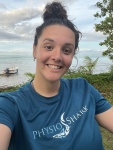
Courtney Burns
courtney.burns@my.jcu.edu.au
Masters by Research
Indigenous Education and Research Centre
Courtney Burns
courtney.burns@my.jcu.edu.au
Masters by Research
Indigenous Education and Research Centre
Investigating the role of diverse knowledge regarding elasmobranchs for improved management of sea Country in North Queensland.
Courtney is a proud Brataualung woman from the Gunaikurnai nation (Gippsland, VIC), whom is deeply passionate about sharks and sea Country health. Courtney’s goal with her research is to be able to change the way the world sees sharks. She aims to promote action in their conservation by understanding the diverse knowledge available and spread word of these findings nation wide.
The links between sea Country and First Nations communities has been known to many for a very long time. However, Courtney, through her research, studies and conservation efforts, aims to bring these relationships to the forefront of mainstream scientific literature and ensure that First Nations knowledge is leading solutions to issues affecting both our Mob, and the world.
Investigating the role of diverse knowledge regarding elasmobranchs for improved management of sea Country in North Queensland.
2025 to 2027
Project Description
This project objective is to explore the role of diverse knowledge to understand and support elasmobranch conservation for improved management of sea Country in North Queensland. It aims to (1) assess the ecological roles of elasmobranchs (sharks and rays) in maintaining ecosystem health, using data from repeated baited remote underwater video systems (BRUVs) and (2) deepen insights into the management interests and aspirations that Traditional Owners of sea Country have for elasmobranchs as part of their sea Country stewardship. The project seeks to highlight the value of diverse knowledge for improved sustainable marine conservation practices in Northern Queensland.
Project Importance
The project will focus on sharks’ role in Caring for Sea Country in Northern Queensland, by investigating the relationship between ecosystem health and shark presence, absence and abundance. The results of this collaborative approach with Traditional Owners will allow diverse knowledge and management interests to co-design projects into the future for the conservation of these animals and reef systems. The significance of this project aligns with multiple objectives of the ‘Reef 2050 Long-term Sustainability Plan’ including: Coral reef habitats maintain good condition and resilience, Populations of protected species are healthy, Traditional Owners’ rights are genuinely recognised and prioritised and inform and drive how benefits are shared, and People and communities take individual and collective action to maintain reef resilience. This project also supports ‘Sea Country’, ‘Partnerships & Capacity’ and ‘Knowledge Systems’ work areas in the ‘Traditional Owner Implementation Plan’ bringing an essential multidisciplinary approach to Caring for Sea Country and shark conservation.
Project Methods
This project aims to draw on diverse knowledge, methods and techniques to gather data for the research project. It will incorporate diverse methods including from marine science (e.g. baited remote underwater video (BRUV)) and Indigenist methodologies (e.g. yarning circles/workshops). This co-design process is essential in framing research questions and methodologies in ways that are relevant to both Indigenous and scientific understandings of ecosystem health.
Project Results
The project has yet to meet objectives and deliverables, due to it's early onset.
Keywords
Behaviour,
Communication / Education,
Coral reefs,
Corals,
Distribution,
Ecology,
Field based,
Fish,
Fishing impact,
Indigenous culture,
Management tools,
Monitoring,
Qualitative techniques,
Quantitative marine science,
Sharks / Rays