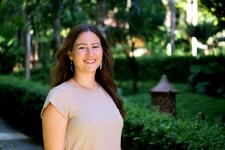
Haley Davis
haley.davis@my.jcu.edu.au
Recipient of an AIMS@JCU Scholarship
PhD
College of Science and Engineering
Haley Davis
haley.davis@my.jcu.edu.au
PhD
College of Science and Engineering
The right algae-rithm for reef recovery – evaluating the restoration potential of heat-evolved Symbiodiniaceae on the Great Barrier Reef
Haley was born and raised in Austin, Texas where frequent travels to the coast first stoked her curiosity in marine and aquatic ecosystems. After earning a Bachelor of Science in Environmental science from Baylor University and interning in various tropical marine ecology research labs, Haley moved to Florida to pursue further studies. Throughout her Master of Science as Florida Atlantic University and her further work at the Central Caribbean Marine Institute, Haley gained an expertise in Caribbean coral reef ecosystems. This expertise became foundational as she began to travel the world's tropics as she worked remotely in data science for the International SeaKeepers Society. Ultimately, it was the firsthand experience of Pacific and Indian Ocean coral reefs that drove Haley back to coral research in the pursuit of her PhD through the AIMS@JCU program.
The right algae-rithm for reef recovery – evaluating the restoration potential of heat-evolved Symbiodiniaceae on the Great Barrier Reef
2026 to 2030
Project Description
This research will assess the feasibility and efficacy of restoring corals with heat evolved (HE) algal symbioses onto the Great Barrier Reef (GBR). To accomplish this, this PhD project will establish a novel coral-algal symbiosis using HE symbiont strains, quantitatively measure the thermal performance of this new combination when exposed to natural conditions on the GBR, and monitor movement of HE symbionts among environmental compartments via continued monitoring of previously-planted Platygyra daedala fragments at an existing field location. This work will expand the coral species which have undergone HE symbiont inoculation and deployment into the field, as well as the sites within which this practice has occurred, creating a critical knowledge base for conducting future risk-benefit analyses of these practices.
Project Importance
To become a viable and scalable restoration option, further work is needed to develop new symbioses between native corals and HE symbionts. Additionally, testing of further novel partnerships to understand their capabilities ex situ and in situ will be vital to the foundations of HE restoration practices in the Great Barrier Reef and beyond. All of this will allow reef managers and practitioners to make informed cost-benefit assessments with regards to implementation of this restoration practice on the GBR.
Project Methods
To accomplish the first goal of this project (creating novel symbioses symbiosis between a coral species native to the GBR area and previously developed HE symbiont strains) Haley will utilize similar methods to those recently established in Scharfenstein et al (2023). We plan to utilize an Acropora species thanks to its status as an ecologically important genus in the GBR region and beyond, as evidenced by their status at the top of the RRAP priority list. Study specimens will be collected, fragmented, and retained in culture at the AIMS SeaSim facility. Tissue samples of each colony will be preserved for baseline symbiont-typing as well as pre-experiment symbiont biodiversity metrics. Fragments will then undergo menthol bleaching using protocols such as those recently utilized in Scharfenstein et al (2023). After successful bleaching, corals will be introduced to HE symbiont strains at concentrations of approximately 10,000 cells per mL (Johnston et al 2025). To verify that HE symbiont uptake has been successful, pre- and post- experiment tissue samples will be extracted, amplified, sequenced at the ITS2 gene region using an ilumina miseq, and categorized following protocols such as those found in Scharfenstein et al (2022). Resulting corals will be kept for further studies.
Another goal of this study is to assess the success of these newly combined coral:symbiont pairings in multiple field locations. Haley will accomplish this by outplanting replicates of each coral colony both in their control form (with both native symbionts, and wild type heat-tolerant symbionts ) and manipulated (HE symbionts) at an established field site near Orpheus Island Research Station (OIRS), and at another location within the Palm Islands (Manbarra Sea Country) allowing us to study the effects of location and providing security from geographically specific risks such as cyclones. Colonies will be assessed every three months for survivorship, bleaching status (utilizing image analysis with Coral Watch color slate for reference), and polyp activity. Additionally, in-situ Fv/Fm measurements will be obtained aboard the research vessel using and imaging PAM. Comparisons of performance will be made between control and manipulated holobionts, geographic ranges, seasons, and species.
A third goal of this project is to investigate the relocation potential of HE symbiodiniaceae in an environment once introduced via restored corals. To accomplish this, Haley will utilize corals (Platygyra daedala) from a previous study which have already been outplanted at one restoration site (OIRS). We will collect tissue samples from restored corals, native corals, sponges, water column, and sediment within a set radius of outplants. These tissue samples will be extracted, DNA will be amplified and sequenced, and sequences will be assigned an identity using similar protocols to above. The symbiont types identified in these environmental compartments will be compared to the known genome of the introduced HE symbiont strains to determine whether a) the inoculated corals retained their HE symbionts over time, and b) those symbionts travelled into other symbiotic organisms or environmental compartments.
Project Results
Through this work, Haley hopes to discover more about the efficacy of symbioses with Heat Evolved Symbiodiniaceae, specifically in ecologically important Acroporid species. This work will help to underline how HE symbionts can be utilized to hopefully restore invaluable ecosystem services to the GBR through vulnerable coral species.
Keywords
Algae,
Benthic,
Climate change,
Controlled Environment,
Coral reefs,
Corals,
Ecology,
Field based,
Genetics,
Management tools,
Molecular techniques,
Ocean warming,
Quantitative marine science,
Temporal change
Supervised By:
Wing Chan (AIMS)